
Inu-oh (2021)

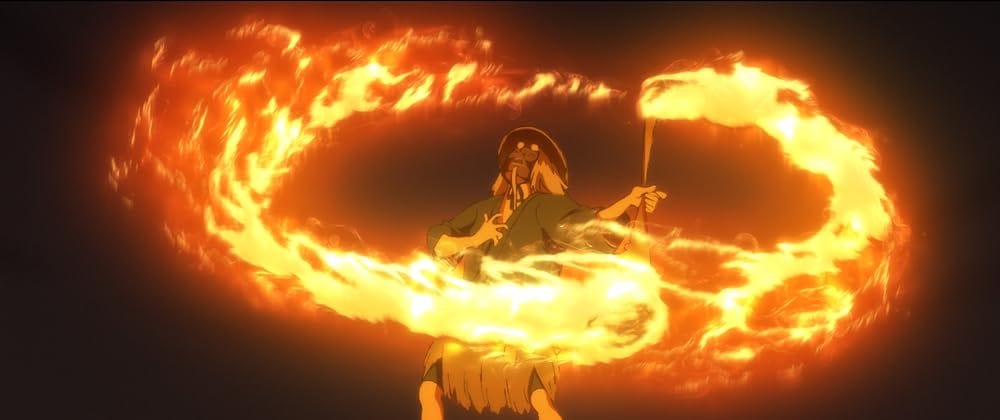
A culmination of song and dance can be enchanting, even more so in a film, presenting both in musical form. Musicals, when crafted with heart, complement the cinematic fantasia well. Masaaki Yuasa's Inu-oh captures the fresh spirit of historical interpretation, and while there is some sacrifice, it is granularly joyous. The marriage between Japanese Noh and rock opera reinvents the presentation of musical theatre in animation, visually justifying the grand scale of each and every successive performance. Inu-oh follows the titular Inu-oh, a high-spirited, deformed boy born with a curse, and Tomona, a blind biwa musician. Both have a chance encounter one night and find harmony in Inu-oh creatively dancing to Tomona's music. To successfully break the curse, the two band together, showcasing their talents. Their relationship is fascinatingly unique, something like a promoter and an artist. Except the promoter, Tomona, is equally as talented, as he writes original lyrics to advertise the one-of-one shows that Inu-oh will put on.
To understand the film's holistic intentionality, our focus should be on the two character studies that are simultaneously occurring. Inu-oh has been shunned his entire life, unable to interact with his family, who have a history of being renowned Noh performers. Perhaps witnessing this or being born into the legacy is the source of his interest, but his talent for it is undeniable, even in the face of being rejected by his father. Ostracism fuels him to find individuality, and the supernatural element of the film kicks in to give him stories to tell. Not just any stories, but the truth. Heike spirits communicate their tales of great feats to Inu-oh, and the narrative uses this to recount historical accuracy. It's conveyed through song to mesh different disciplines, and Yuasa frames him as an icon to the commoners. The modern-day equivalent of a celebrity arriving at a venue near you. During the concerts, we notice the audience imitating dance moves that have now become trendy, so to speak, and Inu-oh works the crowd by having them sing along. His dramatic growth throughout the course of the film, parallel to breaking the curse, is like witnessing the birth of a pop culture sensation, which is obviously anachronistic but all the more exciting.
Inu-oh's partner in entertainment, Tomona, is a former shipwreck diver turned blind musician. He's just as much of a performer, if not more. The angle Yuasa takes with his character is indie, a small-time artist increasingly finding their stride and personality. The viewer watches Tomona alongside his rise to stardom, boasting incredible stage presence, a genuine rockstar. This description can be visually seen down to what he's wearing (huge platform sandals) and using makeup, hinting at slight queer messaging. His songs are typically promoting Inu-oh's backstory in an effort to spread not only his fame but also encourage listening to the unabridged Heike stories. Tomona remains in the shadows for much of the film but arguably has more compelling character complexity. While Inu-oh searches for a calling, Tomona wrestles with identity, not quite fitting into the general perception of biwa musicians. We begin to see experimentation in his live music, incorporating various circus acts in the vicinity to amplify the audience's fear of missing out on either his or Inu-oh's vastly unique spectacles.
Music is a central theme, narratively and structurally. Composer Otomo Yoshihide crafts a hybrid soundtrack, a fusion of traditional instruments, modern vocals, and historical lyrics. The compositions are comprised of various visions Yuasa had for Inu-oh, a classical rock opera. No artistic aspect of the film is meant to be tied down to existing tenets; rather, it is as contemporary as possible. The choreography using break dancing is an instance of Yuasa finding a throughline, and Yoshihide casts a rock veil over biwa instrumentation. Abandoning the idea of anachronism is the objective, and the score makes this apparent in its combination of glam-rock operettas with the timbre of a resonant biwa. Avu-chan's (Inu-oh) vocal performance, while great, feels a bit trained and is hard to pin down as a teenager. On the other hand, Mirai Moriyama (Tomona) has a raw range that perfectly matches the metal inspiration one can hear in the intonation. Sonically, Inu-oh is at its best, bringing forth strong riffs out of ancient instruments.
One of the sacrifices Yuasa inevitably makes to achieve these stylistic liberties is within character-centric territory. The dynamics between characters, or even the phases of their development, are all but snuffed out under the many moving pieces. As stunning as the two leads are when under the spotlight, there is a subtlety to their writing absent. Some of the momentum drags in the contextual first act, but it's really about the interactions between Inu-oh and Tomona being as limited as they are. Individually, they shine, but the lack of a visible relationship for the latter half of the film is noticeable once there are considerable stakes at hand in its closing act, not fully convincing the viewer of what is lost on their path to glory. I have my doubts about to what degree this is intentional due to the heavy musical numbers compensating for gaps in story cogency in the natural flow scenes shimmering in a fragmented reality of colors, culture, and sound. So even amongst the audience being strung along, taking a step back is required to appreciate the magnitude of novelty in this semi-fictional time period.
Yuasa's distinctive animation is the final component of what feels like a hallucination at times. Admittedly, I don't believe this is the height of his usual transformative impressionism. Inu-oh undoubtedly has the qualities we've come to expect: a beautifully freeform technique of movement. A clear visual downside in the subject matter of the film is that the odds of reused animation are high. In part, it's not abnormal to see the same choreography repeatedly in a dance, but there are definitely areas where I would've preferred a change in perspective or shot selection. Though these are relatively minor qualms in the scheme of the expressions Yuasa exhibits through punk rock attitudes. This project has his personal tastes at the forefront, and it is a closer look at his stranger ideas that are perhaps lying dormant. Each frame includes peripheral characteristics that constantly work to reinforce storyboarding continuity, like something as simple as Tomona having his own security detail during a concert. Inu-oh is a courageous ode to music, identity, and uncompromised artistic freedom.