
Marty Supreme (2025)

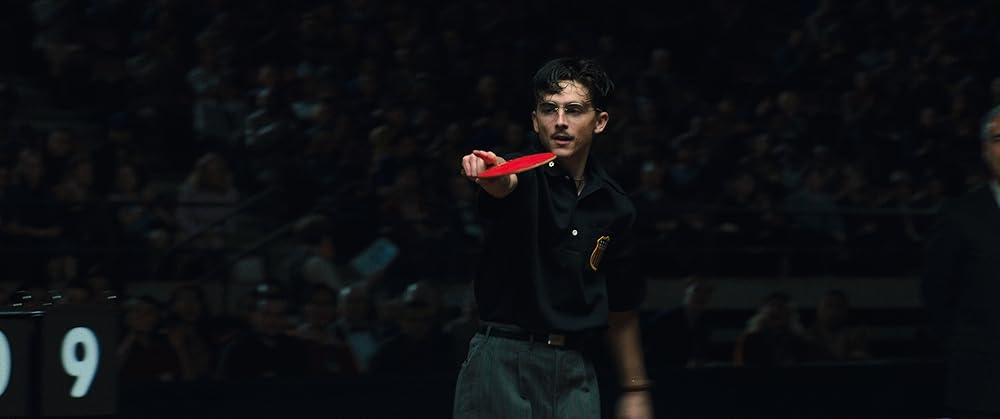
The American table tennis scene in the 50s was a parlor game, further proven by the usage of the name “ping pong” to describe the sport in some of Marty Supreme’s dialogue. Marty (Timothée Chalamet), an aspiring table tennis champion, often corrected anyone misdescribing his passion, especially when it pertained to undermining his determination. These segments largely characterize the film’s gritty New York City setting under Josh Safdie’s direction, lining the streets with hustlers from every way of life looking to make a quick buck, and in this case, through table tennis. The film’s attention to technicalities, or rather the imperfections of the sport, are excellent depictions of the grimy nature of its players and the subsequent arrogance amongst the professional scene. Chalamet has clearly studied the sport, at least enough to deliver a believable rally that doesn’t end with a single forehand return off a serve like depictions of table tennis in most other media. He even incorporates some of the typical swagger that follows one’s ego after having lost a winnable point. There’s more throughout the film that points to well-choreographed sequences, like certain players skirting around the serve toss rule, illegal table touching, or the attention to power over technique since we hadn’t developed high-level spin selection yet. Marty Supreme subtly packages these nuances as tactical play, and it goes a long way for the narrative’s presentation, more so for any enthusiast of the sport.
Bronstein and Safdie’s script conceptualizes Marty’s demeanor through humor. It is, in fact, one of the film’s highlights: Marty’s often ill-timed jokes or occasionally a very serious remark that is more funny than intended. The film itself isn’t quite a character study, but it does study the tension of being on the verge of success. That tension for Marty is a nervousness that he redirects with his quick mouth and wit that get him into trouble. He’s certainly a likable guy when it comes to hearing about his ambition, but it goes without saying he’s not a respectable person, not his methods at least. The consistent lies and the load of hot air he spews all the time to everyone accumulate in the conflicts he finds himself in. Much of the 149-minute runtime is spent finding what really makes Marty tick and how far he’s willing to go for a chance to hit it big. Not necessarily about the money either, just an opportunity at glory. I’d argue the script is stronger than the screenplay, and the series of hijinks eventually evolves into a battered series of unfortunate events that I a handful of times wished ended already. It’s worth noting that his encounters regularly have a role in the next stage of his tunnel vision, except there is an element of fatigue. Chalamet has a hand in this, and while I feel this is likely the best we’ve seen him, there are aspects of Marty Supreme that benefit more from the premise than the actor.
To specifically pinpoint it, his performance relies on physical training he’s gotten with professionals, grunting, and a recurring devil-may-care attitude to returning the ball. The rest of the acting component of his presence is less dynamic and limited in expression. Sure, the goal of Marty Supreme is table tennis, so obviously Chalamet should set his sights on the sport’s immersion. However, I’m not entirely sold on the turmoil of his character, a seemingly large aspect of the storytelling given its incessant obstacles for Marty. Partly because the film chooses to be bombastic in all moments, an easier feat when the character is dressed like a perverted con artist. Chalamet does embody the loudmouthed jerk that Safdie is going for, although it’s a product of many things divorced from an exceptional scene of acting. There’s a conversation to be had about Chalamet’s star power being manufactured, but the film is enjoyable enough to avoid that for now. Ultimately, Marty Supreme succeeds when it’s in the weeds of a match point. When the stakes are high, and the sound of the ball is about all you can hear, the crescendo is electrifying.
The holistic composition of the table tennis scenes capitalizes on Daniel Lopatin’s eclectic score, blending electronica and downtempo ambiance. It accurately complements the intensity of play and repetition of patterns, often integrating industrial sounds, and amplifies the tempo of rallies. It cannot be emphasized enough how appropriately it couples with the editing. Lopatin shifts between suspense and playful jingles adjacent to Marty’s playstyle, a frequent showboater, much to the dismay of his disciplined opponents. The film’s audiovisual storytelling holds its own, alongside Khondji’s composition of low-budget venues and the makeshift gambling in a trashy immigrant-centric city. Theatically, the latter is a slightly underutilized plot mechanic; the aggressive nationalism that was sparsely present only manages to make bold waves during the third act. Even so, the final match is one worth waiting for, a significantly more convincing conclusion than the actual closing scene, and leaves a message foreshadowed by Marty since the beginning. Marty Supreme is a declaration, a homage not to table tennis, but to persistence.
Keep up with me on Letterboxd